DU · CCSU ·OTHER UNIVERSITIES
BCom and BBA Coaching in Ghaziabad
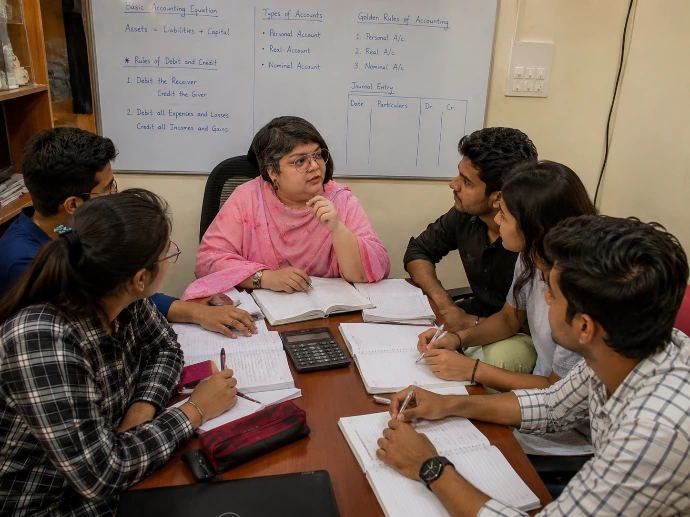
Edu Attack teaches the numerical papers of BCom and BBA at Sector 3, Vasundhara, Ghaziabad — Financial Accounting, Corporate Accounting, Cost Accounting, Management Accounting, Financial Management, Income Tax, Business Statistics and Business Mathematics. Teaching is one to one or in small groups, sized to what the student needs. Classes are taught by Dr. CS Puja Shree Agarwal, who holds a PhD in Commerce, is a Company Secretary registered with the ICSI as member A56253, and has cleared CA Inter and UGC NET Commerce. She has been teaching since 2000, and forty-four of her students hold All India Ranks in CS and CA examinations. Students come from CCS University colleges, from Delhi University, and from private universities. The first three classes are free.
Theory papers are not taught here. That is deliberate, and the reason is below.
WHERE DEGREES BREAK
Why numerical papers are the ones that fail degree students
A commerce degree has papers you can pass by reading the night before, and papers you cannot. The second kind is why students who manage everything else still collapse.
Business Organisation, Business Communication, Environmental Studies, most of Business Law — these reward reading and recall. A capable student can get through them in three days, and many do.
Accounts does not work that way. You can read a cash flow statement a hundred times and still not be able to prepare one. You cannot recall your way through a partner's retirement, or a redemption of debentures, or a marginal costing decision. Either the working comes out of your hand or it does not, and reading has almost nothing to do with which.
This is why a student's overall percentage hides the problem instead of showing it. Somebody sitting at 60% looks fine. Underneath, four theory papers are carrying 70s and three numerical papers are carrying 38s, and nobody has looked closely enough to notice.
And the numerical papers compound. Financial Accounting in the first semester is the base for Corporate Accounting later. Cost Accounting is the base for Management Accounting. Miss the first properly and the second is not difficult, it is unsurvivable — you are being taught something built on a floor you never laid.
That is the whole reason this centre teaches only the numerical papers. Not because the others do not matter. Because the others do not need a teacher in the same way.
AFTER SCHOOL
Nobody checks your working after Class 12
The biggest difference between school Accounts and degree Accounts is not difficulty. It is that nobody reads your work any more.
You scored 88 in Class 12 Accounts. Papa told everyone. And you believed it too — this subject was yours.
Then college started. First semester, Financial Accounting. Eighty students in the room. Sir works the sum on the board, you copy it down. At home you sit with it and get stuck somewhere. You are not even sure where. You move on. Nobody asks where you got stuck. Second month. Two chapters behind now, but it feels manageable. There is still time. You keep attending, the copy fills up, it even looks good. Third month. Exam. And that is when you find out that what you had been writing for three months was wrong. The same mistake, every single time. Nobody had looked.
In Class 12 that mistake would have been caught in the first unit test. A teacher marked your copy, drew a red line where it went wrong, and told you. You fixed it that week and never made it again. In college there is no red pen.
The subject did not get harder. The person who used to tell you left.
The semester system takes away the last warning too. Three months, six papers, then it is over. No unit test in September, no half-yearly, no parent-teacher meeting. A student can be lost from week three and get no signal at all until results. That is why batches here are capped at ten. Ten is roughly the number of copies one person can actually read every week. Everything else on this page follows from that one number.
TWO SYLLABI, ONE ROOM
DU and CCSU papers are not the same, and both sit in this batch
A Ghaziabad classroom has students from DU University colleges, CCS University colleges, and students from private universities.
Their papers diverge more than the syllabus list suggests.
The chapter names match. Financial Accounting is Financial Accounting everywhere, and the standards do not change by university.
What differs is depth and question style. DU papers push further into adjustments and application, and reward a student who can handle an unfamiliar variation. CCSU papers follow a more predictable pattern, and reward thorough coverage of the standard sums. The internal assessment weightings differ too, which changes how much a bad exam actually costs you.
Teaching both in one room only works if the teacher knows exactly where the two diverge, and sets different practice from the same lecture. That is how this batch runs: common teaching, separate question banks, separate paper practice before each university's exams.
If you are a DU student who assumed a Ghaziabad centre would only handle the CCSU pattern, that assumption is worth checking. Ask about it in the free classes.
WRITTEN FOR DU PAPERS
Why DU papers send students looking for a teacher
Most students here are from Delhi University, and that is not an accident. It is what the papers do.
DU's numerical papers push into application. The sums are unfamiliar, the adjustments are not the ones you practised, and the internal assessment will not carry you if the written paper goes badly. You cannot get through a DU Accounts paper by doing the standard questions and hoping the same ones turn up.
CCS University and most private university papers are built differently. There is more theory in the syllabus, the numerical questions follow a more predictable pattern, and internals carry more weight in the final result. A capable student can often manage those alone, and many do — which is why CCSU students come looking for a teacher far less often than DU students.
That is not a comment on the students. It is a comment on what each paper asks for.
So the teaching here is pitched at DU's level. CCSU, private university and BBA students sit in the same groups and hear the same lectures. What changes is the practice — a different question set, matched to their own paper pattern, before their own exams.
If you are preparing for DU, this is the paper the teaching was built around. If you are not, you are being taught slightly above your paper, which has never hurt anybody.
DOUBLE LOAD
Running a degree and a professional course at the same time
The overlap between a BCom paper and its CA, CS or CMA equivalent is smaller than students expect, and assuming otherwise is how both get failed.
The topics overlap. The rigour does not. CA Inter Accounting goes considerably deeper into standards and disclosure than any BCom paper requires, and Company Law at CS Executive level is not the Company Law in a degree syllabus.
So two failure patterns show up, and they are opposites. A student preparing only from professional-course material over-answers the degree paper, spends forty minutes on a question worth eight marks, and runs out of time. A student preparing only from degree material walks into a professional exam under-prepared on the standards and gets caught on presentation.
The efficient route is one base and two layers of practice on top of it. That is what gets set here, because the same teacher handles both levels — she taught CS, CA and CMA papers at a professional coaching institute for three years, and holds CS and CA Inter herself.
So the two can be taken together, as one arrangement rather than two. The base is taught once. The practice splits into two layers from the same lecture — one set written the way a degree examiner wants it, one set written the way a professional examiner wants it.
Right now a student doing both is usually paying two institutes, sitting through the same topic twice, and being taught it two ways that do not agree. That is expensive and it is confusing, and the confusion costs more marks than the expense costs money.
This is the cheaper version and the coherent one. Ask about it in the free classes if it applies to you.
NUMERICAL PAPERS ONLY
Papers taught — accounts, costing, finance and tax
Accounting
Financial Accounting · Corporate Accounting · Advanced Accounting
Costing
Cost Accounting · Management Accounting
Grouped by discipline rather than by semester, because semesters differ across universities and a semester list dates immediately.
Finance
Financial Management · Financial Statement Analysis · Fundamentals of Investment · International Finance
Tax
Income Tax Law and Practice · GST and indirect tax · Corporate Tax Planning
Quantitative
Business Statistics · Business Mathematics
A note on Corporate Accounting, because it is the paper students ask about most. It is not one subject. It is share capital, debentures, redemption, amalgamation, internal reconstruction, holding company accounts and liquidation, and each of those arrives with its own format and its own set of legal provisions. There is no single unifying logic to lean on the way there is in Financial Accounting, which is why students who were comfortable in the first year often come apart here — pattern recognition does not transfer.
Half of that paper is company law applied to accounts. Dr. Agarwal is a Company Secretary, which is a different and better-fitted background for it than accounting alone.
Theory papers are not taught here. If Business Communication is your problem, this is not the right place, and it is better to know that now.
CA, CS and CMA papers are taught as an add-on for students already taking a degree paper here, not as a standalone course. That is a deliberate limit — see the section above on running both at once.
THE ARRANGEMENT
How fees and timings are decided here
Fees are charged per subject as a lump sum, and the figure follows how many hours of teaching the paper will actually take you.
That is unusual enough to explain.
School tuition can carry one monthly price because it is one product — one syllabus, one batch, one pace, everyone starting in April. Degree coaching is not one product, and pretending it is would mean overcharging half the students to undercharge the other half.
Consider who actually walks in. One student arrives in the first month of the semester and wants the paper done properly from the beginning. Another arrives ten weeks before the exam with nothing done. One works a job and can only come on two fixed evenings. One needs the whole of Corporate Accounting; another needs amalgamation and internal reconstruction and nothing else. And students do not learn at the same speed, which is not a polite thing to write on a website but it is true, and it changes the number of hours more than any of the other factors.
Layer the syllabus on top of that — BCom Hons, BCom Programme or BBA, CCSU or DU — and a single price list becomes a fiction.
So the fee follows the hours. This is how professional work is normally quoted: look at the job, then price it. It is not how a coaching class sells a course, and that difference is deliberate.
PAPERS
PART PAPERS
Numerical papers only, priced per subject
Individual chapters taken as short arrangements
FEES
Lump sum per subject, based on hours required
STARTING FROM
₹6,200 per subject
QUOTED
After the three free classes
GROUP SIZE
One to one, or a small group. Sized to need
COURSES
BCom Hons · BCom Programme · BBA
UNIVERSITIES
Delhi University · CCS University · others
TIMINGS
Set by discussion. Working students grouped together
MODE
Face to face
LOCATION
Sector 3, Vasundhara, Ghaziabad – 201012
TRIAL
Three free classes
Which is why the quote comes after the three free classes.
Those three sessions are not a sales trial. They are when it becomes clear how much ground there is to cover, and no honest number can be given before that.
Timings are fixed by discussion once the group is formed.
College hours differ by university and by semester, and working students need particular evenings. A timetable set before the group exists only suits whoever booked first.
THE COMMUTE
If you study in Delhi and live in Ghaziabad
Most students here do not study nearby. They study in Delhi and they live on this side of the Hindon.
Work out the day. A college in North Campus or South Campus, a flat in Vaishali or Vasundhara or Indirapuram, and roughly three hours gone on the metro before anything else happens. Add coaching in Delhi to that and you are asking for a fourth hour, after college, before the journey home, three days a week, for a whole semester.
Nobody sustains that. They start, they miss two weeks in October, and by December they have stopped going.
Coaching ten minutes from where you sleep is the only version of this that survives a full semester. That is the entire reason this centre is on this side and not in Laxmi Nagar.
The same was true at the old Vaishali centre. The students came from colleges across Delhi and lived within a few kilometres of the classroom. Vasundhara sits in the same catchment.
From Evening drive
Vasundhara — Sectors 1, 2, 3, 4B, 9 Under 10 minutes
Vaishali Under 10 minutes
Indirapuram — Ahinsa Khand, Vaibhav Khand 15 to 20 minutes
Edu Attack, 1245, Sector 3, Vasundhara, Ghaziabad,
Uttar Pradesh – 201012
+91 93110 05623
BEFORE JOINING
What students ask before joining
In this section, you can address common questions efficiently.
Yes. Most students here are from DU, and the teaching is pitched at the DU paper — application-heavy, unfamiliar adjustments, no internal assessment to fall back on. If you are commuting to North or South Campus, this is ten minutes from home instead of an hour the wrong way.
You will sit in the same group and hear the same teaching, and you will get a separate practice set matched to the CCSU paper before your exam. The teaching is pitched slightly above what your paper asks for, which costs you nothing.
Delhi University's, as the base. The chapters are the same everywhere; what differs is how far a paper pushes into application, and DU pushes furthest. Building the teaching around the harder paper and adjusting the practice downward works. Doing it the other way round does not.
No. Only the numerical papers — accounts, costing, finance, tax, statistics and mathematics. Theory papers do not need a teacher in the same way and pretending otherwise would waste your money.
Not necessarily, but it changes what we do. Six weeks is enough to fix two or three chapters properly, and it is not enough to fix a whole paper from scratch. Come for the free classes with your notebook and you will get an honest answer rather than an optimistic one.
Yes. Back-paper students are taken for the single paper rather than the full batch. It is usually a shorter, more intense arrangement, and it works because there is exactly one thing to fix and a real deadline to fix it by.
They clash less than you think in content and more than you think in method. The same teacher handles both levels here, so the practice you get is set for both papers rather than for one and hoped for the other.
It varies. Some students take the paper one to one. Some sit in a group of three or four. The group never gets larger than one teacher can walk around and read in an hour, because reading the working is the point. If you want to know the size of the group you would join, ask before the trial classes and you will be told the actual number.
Fees are per subject as a lump sum, starting from ₹6,200 per subject, and the exact figure is quoted after the three free classes. It depends on which paper, which university, whether you join a batch or take it one to one, and how far behind you are starting. The trial classes are what make that last part knowable.
Because the fee follows the hours, and the hours depend on where you are starting from. A student who needs two chapters fixed and a student who has never understood the paper are not the same amount of work. One number for both would be unfair to one of them. Three classes is when it becomes clear which one you are.
Yes, and it is common. Amalgamation and internal reconstruction, or cash flow alone, or one costing method — these are taken as short arrangements priced for what they are. You are not made to buy the whole paper to get the part you are stuck on.
Say so at the start. Working students are usually placed together so the group's timing is built around the evenings that actually work, rather than around whoever booked first.
Yes. One to one costs more and moves faster, and it suits a student with an exam close or a specific chapter to repair. A batch suits a student doing the paper properly from the beginning.
Yes, when the paper is the same. Grouping here is by topic, not by degree. A BBA student doing Cost Accounting and a BCom student doing Cost Accounting are working on the same material, and separating them would only make both groups smaller and slower.
Where the two syllabi diverge — and they do, more in the later semesters — the teaching stays common and the practice sets differ. Same principle as with CCSU and DU.
Timings are fixed by discussion once the group is formed, because college hours differ by university and by semester. Tell us your free evenings on WhatsApp and we will tell you which group fits.
Sector 3, near Vanasthali School Road. The full address and map are above.
THREE CLASSES, NO FEE
Sit in three classes before you pay
Bring your notebook and the last paper you wrote. Between those two we can usually tell where the working is going wrong within the first class, and you can tell whether this is worth your Tuesday evenings.
If it is not a fit, you will be told so. Better in week one than in the week before your exam.
Call Between 12 noon to 4pm